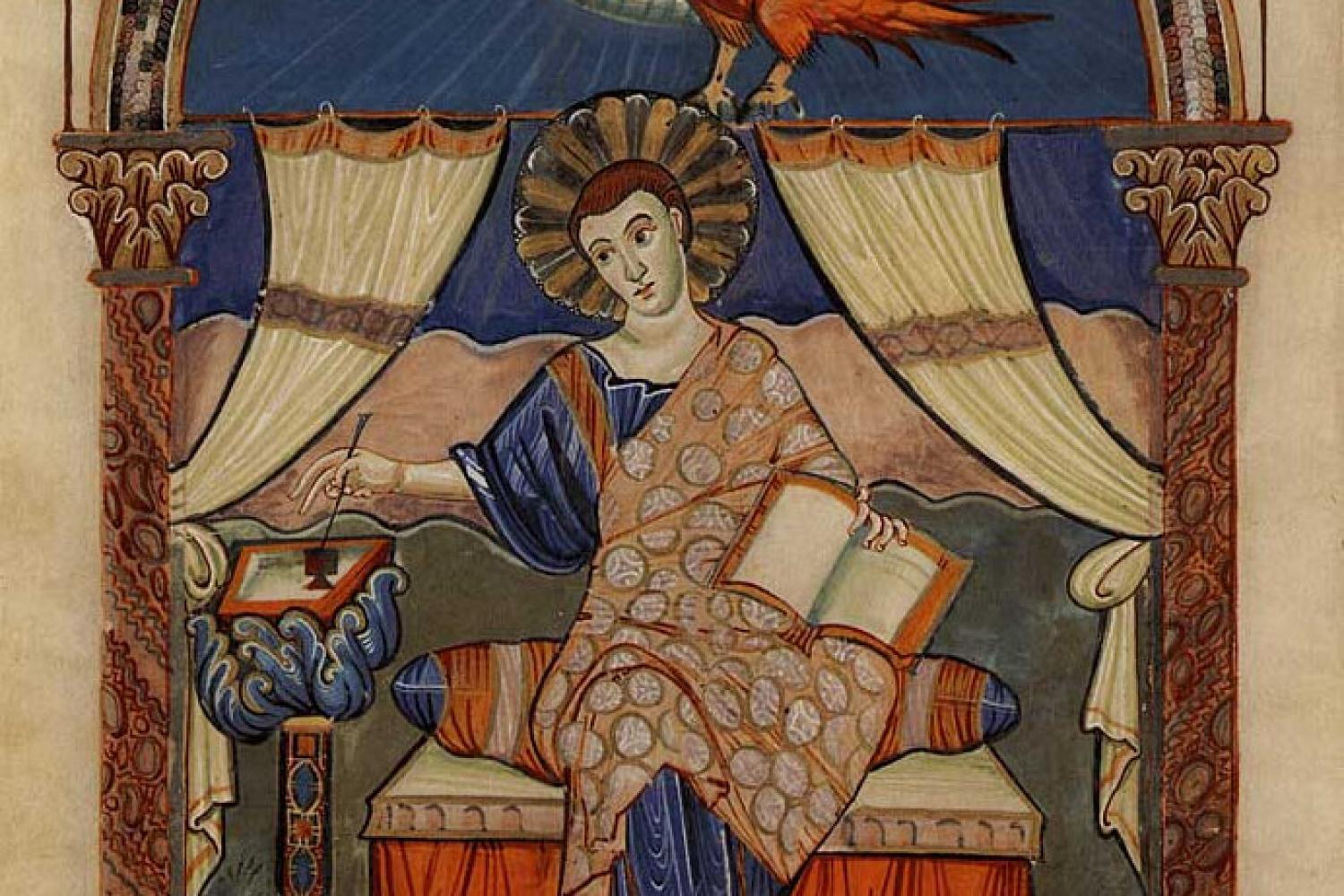
Reflection for the Feast of St. John, Apostle and Evangelist, December 27
from Pal.lat.50, Lorscher Evangeliar, sec. IX (© Biblioteca Apostolica Vaticana)
Mending nets
When two young Jewish fishermen sat by the Sea of Galilee, mending their nets with their father, a man walked by and said, “Follow me.” Their response reveals the startled glimmer of recognition they must have had in that moment: “Immediately they left their boat and their father and followed him” (Matthew 4:22). In this rabbi who was calling them, James and John, the sons of Zebedee – tradition holds that John was the younger of the two – caught a glimpse of something for which, as faithful Israelites, they had been waiting all their lives.
John must have often gone back in his mind to that moment when he left his nets to follow the Messiah. Yet during his three years at Jesus’ side, watching him pray, teach, raise a dead child, and calm the wind and the waves, the fisherman could not have imagined that one day he would watch his Master die on a cross. He could not have known that, as he saw his friend’s body placed in the tomb, the words he had learned as a Jewish child would take on an infinitely greater meaning: “Your face, O Lord, I seek; hide not your face from me” (Psalm 27:8-9).
“Son of thunder”
The apostle John must have been an impetuous young man. We glimpse what Jesus meant when he called Zebedee’s sons, “sons of thunder,” when they ask if they might call down fire from heaven on those who did not welcome their Lord (Luke 9:51-55). The brothers also ask – oblivious as to what they are asking – to sit at the Lord’s right hand in his “glory,” a glory they likely conceived in earthly terms (Matthew 20:20-28). Both times, they are reprimanded. But in all this, John, whom tradition identifies as the “beloved disciple” in John’s gospel, was learning love.
Love was near enough to touch in those three years as a disciple, and above all in those three days that began with his Master washing the disciples’ feet like a slave. John is the only apostle the gospels record as present when Jesus died, watching with Jesus’ mother and other women as the Son of God cried out to his Father. John heard another word there, to Mary, about him: “Behold your son.” And to him, “Behold your mother,” entrusting her to his care (John 19:26-27). Finally, he watched as a soldier thrust a lance into Jesus’ side and the blood of the Covenant flowed over the earth. “An eyewitness has testified,” John’s gospel insists at this point, “and his testimony is true” (John 19:35).
The love John received would make him run faster than Peter, when Mary Magdalene came to tell them that she had found the tomb empty. But it would also make him wait until Peter preceded him in: “Then the other disciple also went in … and he saw and believed” (John 20:8). He believed, though he could not yet comprehend until his eyes took in the reality of the Risen One wishing them peace, or standing by a fire, beckoning the apostles to shore. The others could not make out who it was, but love had given this disciple eyes to see: “It is the Lord!” (John 21:7)
The one who sees far
The First Letter of John begins, “What was from the beginning … what we have seen with our eyes … and touched with our hands….” (1 John 1:1). The disciple who has seen and touched the Word made flesh cannot forget it. That experience taught him: “God is love, and whoever remains in love remains in God, and God in him” (1 John 4:16).
Tradition holds that John, the only one of the apostles not to be martyred, lived at Ephesus with the Mother of God after the apostles had been scattered. During the reign of the Emperor Domitian, he was exiled as an old man to the island of Patmos. There, the one to whom love had given clear sight to see as far as “the beginning” – iconography presents St. John with an eagle to symbolize this – is given to see also the end.
“I, John, your brother” the Book of Revelation begins (Revelation 1:9). The visions in that book, given to strengthen the Church during a time of persecution, are also the full revelation of Christ’s Lordship. Yet it was a familiar voice that John heard in the cry, “I am the Alpha and the Omega, the beginning and the End!” (Revelation 21:6). He had seen, heard, and touched the Lord of time and history, who bore the face of his Master and friend.
We pray that the love of St. John, who left all to follow Jesus, who remained with Christ during his crucifixion, who saw, in the fulness of time, his Alpha and Omega, may ever be our guide and intercessor.
May the beloved disciple, the one whom Jesus loved, who has unlocked for us the secrets of the Word who is Life, giving testimony to the Word of God and witness to Jesus Christ whom he had seen, continue to reveal the mysteries of the Word, that we may grasp with proper understanding what he has so marvelously brought to our ears.
And may we all come to understand the wisdom he taught.
We ask this of You, Source of all being, in the name of Jesus and through the power of the Holy Spirit, God, forever and ever. Amen.